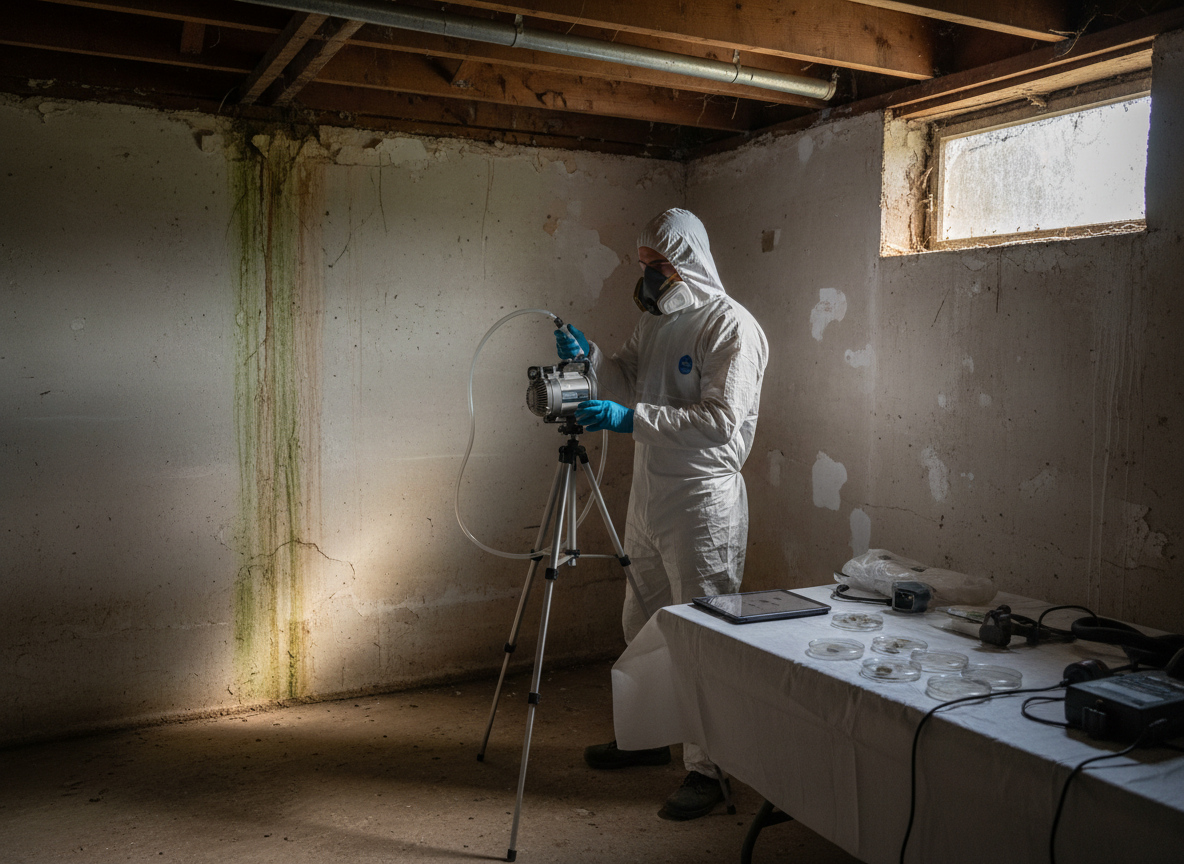
Mold spore testing in Mentone requires careful attention to the area's older housing stock along Mentone Boulevard and near Zanja Creek, where cool winter rains and occasional creek overflow introduce moisture into crawl spaces and wall cavities. Technicians collect air samples from multiple rooms plus outdoor controls, then swab visible stains on drywall or baseboards to compare spore types. Hot, dry summers increase reliance on air conditioning, which can create condensation behind walls if units are poorly maintained, leading to hidden colonies that only lab analysis reveals. San Bernardino County building practices from earlier decades often left limited ventilation in attics, so testing protocols include checking HVAC returns and supply ducts that connect to Redlands and Yucaipa homes with similar construction.
Edge cases arise when properties sit on the slight slopes toward Calimesa, where poor drainage funnels water against foundations during rare heavy rains. In these situations, spore counts inside may spike even when no visible mold appears, because gypsum board wicks moisture upward from the slab. Testing crews note that Mentone's Mediterranean climate means summer heat can dry surface moisture quickly, masking active growth until winter returns. Samples are sent to independent labs for genus-level identification rather than relying on visual estimates, because Penicillium and Aspergillus spores common in the Inland Empire look identical under a microscope but require different remediation steps.
Homeowners sometimes attempt DIY kits, but these miss the distinction between normal outdoor spore levels and indoor amplification caused by leaks around older window frames common in Mentone. Professional testing documents baseline conditions before any cleanup, which matters when insurance claims involve nearby Yucaipa properties that share similar soil and drainage patterns. Results guide whether air scrubbers or containment barriers are needed, especially in multi-unit buildings where spores can migrate through shared attics.
Technician insight
In Mentone, the thing that catches most people out with mold spore testing is assuming dry summer air means no problem. Older homes near Zanja Creek often hold winter moisture in wall cavities that only shows up when we sample during the first cool spell, and the creek's seasonal flow changes drainage patterns that affect slab-edge homes in ways Redlands properties rarely see.
Hidden Spores After Winter Rain Near Zanja Creek
A Mentone homeowner noticed musty odors in a back bedroom after heavy winter rains. Testing revealed elevated Aspergillus levels in the wall cavity adjacent to the creek side of the lot. We collected air and swab samples, confirmed the source through lab results, and provided a targeted report that allowed focused drying before any removal work began.
How it works
- 1
Initial Assessment
Technician inspects the property layout, notes proximity to Zanja Creek, and identifies likely moisture entry points from the home's age and construction.
- 2
Sample Collection
Air samples are taken in living areas, bedrooms, and HVAC returns while outdoor control samples establish regional baselines typical for San Bernardino County.
- 3
Laboratory Analysis
Samples are sent for spore identification and count comparison to determine if indoor levels exceed normal outdoor concentrations.
- 4
Report and Recommendations
Findings are delivered with clear explanations of any elevated genera and suggested next steps for containment or further inspection.
Pricing
Cost depends on square footage, number of samples required, and whether HVAC or crawl space access is needed.