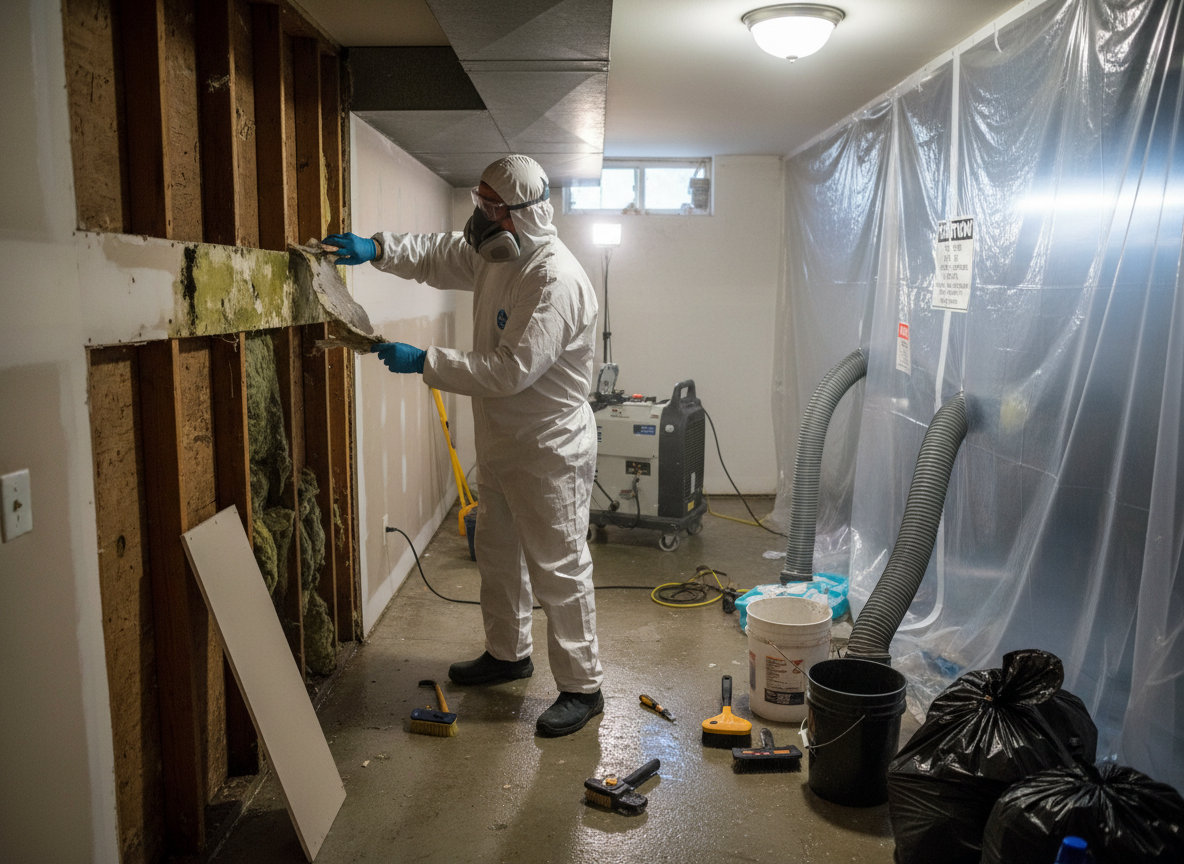
Water intrusion from winter rains or Zanja Creek overflow often reaches crawl spaces and wall cavities in Mentone homes built before modern grading standards. Once moisture sits against older framing or stucco, mold colonies form within 48 hours even when surface walls appear dry. Technicians use moisture meters and infrared cameras to map hidden saturation that standard visual checks miss, then isolate the zone before any demolition begins.
Hot dry summers in San Bernardino County force air conditioning units to run long cycles that can pull humid air through small foundation cracks near Redlands Road or Yucaipa Boulevard properties. This creates repeated condensation inside ductwork and under slabs. Remediation crews remove affected insulation, treat subflooring with EPA-registered antimicrobials, and install temporary negative air machines to keep spores from migrating into living spaces during the work.
Calimesa and Mentone properties on sloped lots near the creek frequently experience water wicking upward through porous concrete. After containment and removal, drying protocols run for several days with commercial dehumidifiers sized for the square footage and local humidity swings. Final clearance testing confirms spore counts match outdoor baselines before any reconstruction materials are delivered.
Technician insight
In Mentone, the thing that catches most people out with water damage mold remediation is how quickly moisture travels along the clay-heavy soil near Zanja Creek during cool winter nights. Homeowners often stop drying once the floor feels dry, but the slab edge stays damp for weeks and feeds mold back into the wall bottom.
Winter Creek Backup in Mentone
Heavy rain caused Zanja Creek to back up into a crawl space on a home two blocks from Mentone Park. We found standing water against the foundation and active mold on floor joists. After removing affected insulation and drying the space for four days, clearance samples passed and the owner could begin floor repairs without further spread.
How it works
- 1
Initial Assessment
Technicians arrive within hours, document visible water lines, and use meters to locate moisture behind walls and under floors.
- 2
Containment Setup
Plastic barriers and negative air pressure isolate the work zone to prevent spores from reaching unaffected rooms.
- 3
Material Removal
Saturated drywall, insulation, and baseboards are cut out and bagged for disposal following county guidelines.
- 4
Drying and Treatment
Commercial equipment dries the structure while antimicrobial agents address remaining surfaces.
- 5
Clearance Testing
Air samples confirm mold levels have returned to normal before the area is released for repairs.
Pricing
Pricing varies with the extent of hidden moisture and access difficulty in older Mentone homes; an on-site assessment provides the exact scope.